Table of Contents
Open Table of Contents
Résumé pour la direction
Scenario
L’équipe Nautilus DevOps cherche à standardiser le provisionnement réseau dans Azure en adoptant une approche Infrastructure as Code (IaC). L’objectif est de remplacer les créations manuelles ou semi-manuelles par un modèle déclaratif, versionné et réutilisable, afin de garantir des déploiements homogènes entre les environnements.
Dans ce cas, le besoin portait sur le déploiement d’un réseau virtuel Azure nommé arm-vnet-datacenter avec une plage d’adressage 192.168.0.0/16, tout en appliquant les standards de marquage de l’entreprise avec les tags displayName=arm-vnet-datacenter et Environment=KKE-datacenter.
Cette démarche répond à plusieurs enjeux métiers : amélioration de la gouvernance cloud, réduction des écarts de configuration, facilitation des contrôles de conformité et accélération des opérations de déploiement grâce à des composants réutilisables et audités.
Resolution
Le réseau virtuel a été mis à jour directement dans le fichier de template ARM au sein de l’environnement de travail, puis déployé via Azure CLI au sein du groupe de ressources cible (kml_rg_main-77bb569dcf9d4e6c). Le résultat obtenu est un provisionnement cohérent, reproductible et aligné sur les standards de nommage et de tagging attendus.
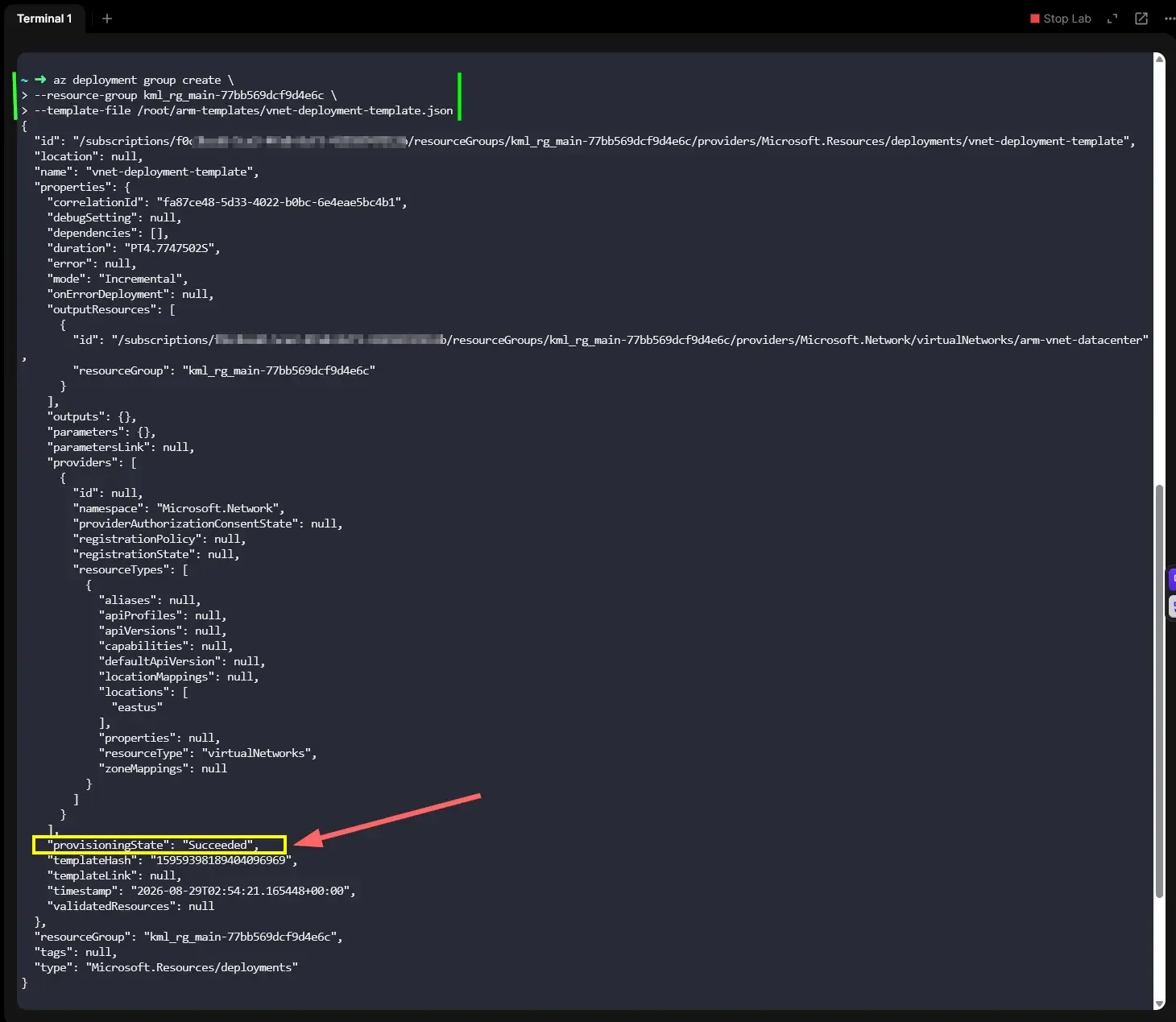
La validation du déploiement confirme que la ressource arm-vnet-datacenter a bien été créée avec la plage CIDR demandée et les métadonnées d’entreprise associées, avec un état de provisionnement validé à Succeeded.
Technical Implementation
Topology
The target architecture is intentionally simple and focused on network standardization through declarative deployment. The solution provisions a single Azure Virtual Network with the following parameters:
- Resource type:
Microsoft.Network/virtualNetworks - Virtual network name:
arm-vnet-datacenter - Address space:
192.168.0.0/16 - Tags:
displayName=arm-vnet-datacenterEnvironment=KKE-datacenter
The deployment is executed headlessly through Azure CLI, utilizing a JSON ARM template updated via terminal text editors (vi). This approach makes the network configuration deterministic and suitable for source control and change reviews.
Architectural Insight: Declarative IaC such as ARM, Bicep, or Terraform is superior to imperative GUI/CLI creation because the desired end state is explicitly documented in code. This improves state tracking, enables peer review through pull requests, and reduces configuration drift by ensuring environments are rebuilt from the same reviewed definition instead of relying on manual operator actions.
Action
The implementation consisted of locating the existing ARM template in /root/arm-templates/vnet-deployment-template.json, modifying its configuration to match the required network space and corporate tags, and executing the deployment via Azure CLI.
To complete this effectively within the lab environment, the JSON structure was directly modified using the vi text editor to reflect the new target state.
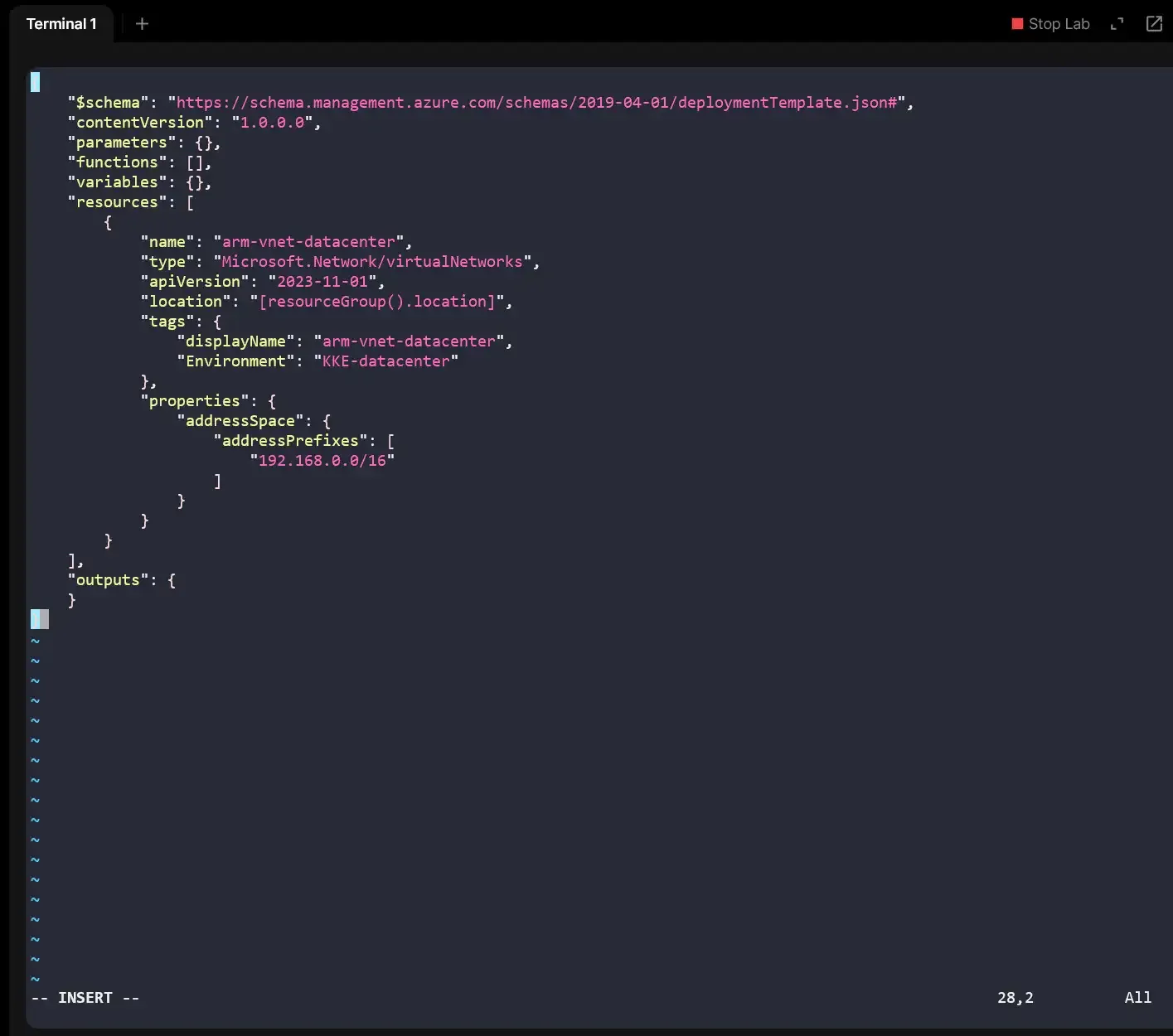
1. Modified ARM Template
{
    "$schema": "https://schema.management.azure.com/schemas/2019-04-01/deploymentTemplate.json#",
    "contentVersion": "1.0.0.0",
    "parameters": {},
    "functions": [],
    "variables": {},
    "resources": [
        {
            "name": "arm-vnet-datacenter",
            "type": "Microsoft.Network/virtualNetworks",
            "apiVersion": "2023-11-01",
            "location": "[resourceGroup().location]",
            "tags": {
                "displayName": "arm-vnet-datacenter",
                "Environment": "KKE-datacenter"
            },
            "properties": {
                "addressSpace": {
                    "addressPrefixes": [
                        "192.168.0.0/16"
                    ]
                }
            }
        }
    ],
    "outputs": {
    }
}vnet-deployment-template.json
2. Resource Group Discovery and Deployment
First, locate the target resource group matching the lab criteria using a filtered query:
#!/usr/bin/env bash
set -euo pipefail

RESOURCE_GROUP=$(az group list --query '[].name' --output tsv | grep 'kml')

az deployment group create \
  --resource-group "$RESOURCE_GROUP" \
  --template-file /root/arm-templates/vnet-deployment-template.json
deploy-vnet.sh
3. Verification
Verify the deployed virtual network properties, address space, and associated tags using YAML output format for complete visibility:
#!/usr/bin/env bash
set -euo pipefail

az network vnet list \
  --resource-group kml_rg_main-77bb569dcf9d4e6c \
  --query "[].{Name: name, AddressSpace: addressSpace.addressPrefixes, Tags: tags}" \
  --output yamlverify-vnet.sh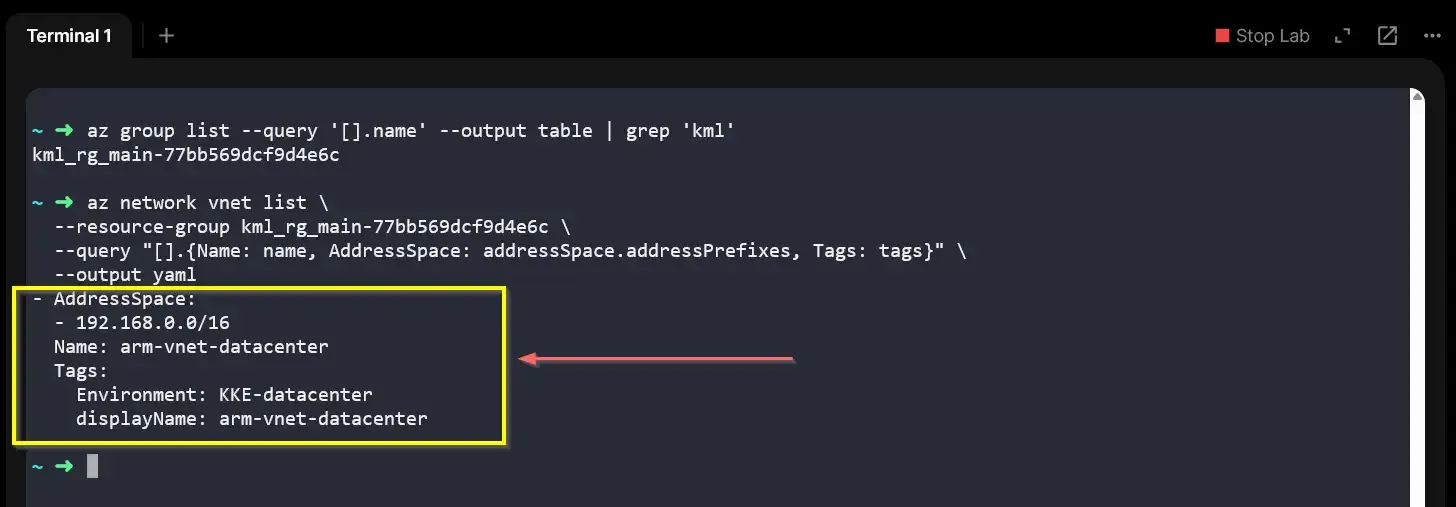
The deployment concluded with a Succeeded provisioning state. The VNet properties precisely match the governance requirements for CIDR and tagging standards.
Always validate JSON syntax and verify bracket/comma placements within the tags and properties blocks when modifying ARM templates manually via vi to prevent deployment validation failures.